British Armoured Divisions and their Commanders, 1939-1945 by Richard Doherty
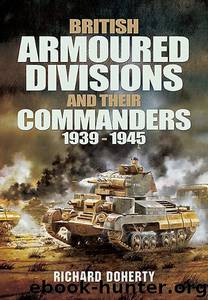
Author:Richard Doherty [Doherty, Richard]
Language: eng
Format: epub
Tags: HISTORY / Reference
ISBN: 9781473826748
Publisher: Pen and Sword
Published: 2013-07-15T21:00:00+00:00
The Defence Committee, prompted by the Ministry of Supply, made clear that it preferred not to rely on American production for Britain’s tank needs in the remainder of the war ‘on the grounds that it was undesirable to let it appear that the war had been won by American tanks. A preference to continue with Churchill and Cromwell was stated’.
As well as Tiger the Germans had developed another new tank, Panzer Mark V, or Panther. A medium tank weighing 45 tons – half as heavy again as demanded in the original specification – it carried a 75mm gun twice as long as that of the improved Panzer Mark IV. On Hitler’s orders the gun was made even longer. Having overcome teething problems, Panther proved an excellent tank; a powerful gun, thick armour and speed all contributed to it being the best German tank of the war. It was developed to combat the Russian T-34 and was superior to it in most respects, except that Germany could not match Soviet production levels: only 5,500 Panthers were built between 1942 and 1945 whereas 11,000 T-34s rolled off the production lines in 1944 alone. Although there are no doubts about the technical qualities of the Panther, it was over-engineered which meant longer time in production and more complicated maintenance in the field. Had the Germans been willing, a captured T-34, which provided the specification for Panther, could have been used to reverse engineer a German version, of which many more could have been built; but German engineering hubris ensured that this simpler Panzer Mark V did not develop beyond a thought.
It is worth considering the T-34 briefly. The best all-round tank of the war, it was also built in the greatest numbers, with over 57,000 produced by 1945 (the USA produced over 50,000 Shermans). Design work started in 1936, based on the BT-7. With a high-velocity 76.2mm gun, low turret, sloped armour, powerful engine and Christie suspension, T-34 was a shock to German panzer crews. It was later fitted with an enlarged turret and the 85mm anti-aircraft gun to become T-34/85. Wide tracks and excellent suspension allowed it to operate effectively, even on ground covered in snow or mud, giving it a tactical as well as numerical superiority over its adversaries. Not surprisingly, T-34 remained in service and production after the war and its production totals have been exceeded only by its successor, the T-54.
Also under discussion at this time were armoured warfare tactics since it was not clear whether those that had worked in the desert would translate to Europe. However, it was appreciated that the conditions experienced in Tunisia approximated more closely to those of Europe and that the armoured division as deployed in Tunisia, with its armoured brigade and lorried infantry brigade, was well balanced. Its only apparent defect lay in having only an armoured car regiment for reconnaissance and so it was decided to use an armoured regiment instead.
The revised organization was not viewed as definitive since emphasis was
Download
This site does not store any files on its server. We only index and link to content provided by other sites. Please contact the content providers to delete copyright contents if any and email us, we'll remove relevant links or contents immediately.
| Africa | Americas |
| Arctic & Antarctica | Asia |
| Australia & Oceania | Europe |
| Middle East | Russia |
| United States | World |
| Ancient Civilizations | Military |
| Historical Study & Educational Resources |
Room 212 by Kate Stewart(5119)
The Crown by Robert Lacey(4814)
Endurance: Shackleton's Incredible Voyage by Alfred Lansing(4780)
The Iron Duke by The Iron Duke(4354)
The Rape of Nanking by Iris Chang(4211)
Joan of Arc by Mary Gordon(4109)
Killing England by Bill O'Reilly(4001)
Say Nothing by Patrick Radden Keefe(3984)
I'll Give You the Sun by Jandy Nelson(3447)
Shadow of Night by Deborah Harkness(3367)
Hitler's Monsters by Eric Kurlander(3341)
Mary, Queen of Scots, and the Murder of Lord Darnley by Alison Weir(3210)
Blood and Sand by Alex Von Tunzelmann(3203)
Eleanor & Park by Rainbow Rowell(3171)
Darkest Hour by Anthony McCarten(3129)
Margaret Thatcher: The Autobiography by Thatcher Margaret(3081)
Book of Life by Deborah Harkness(2938)
Red Famine: Stalin's War on Ukraine by Anne Applebaum(2932)
The One Memory of Flora Banks by Emily Barr(2863)
